


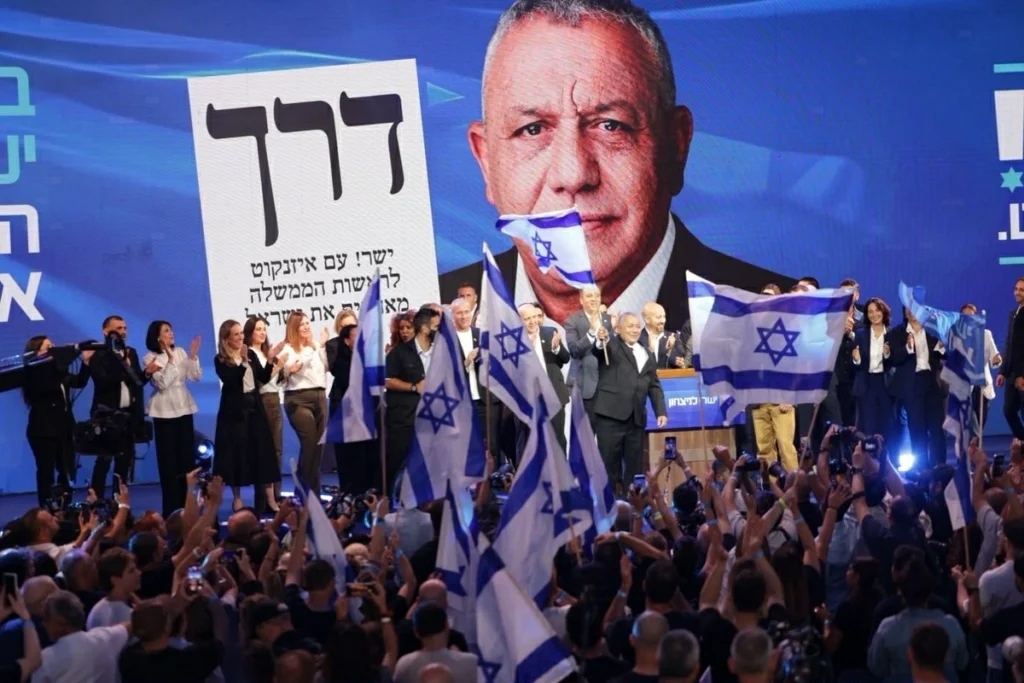
JERUSALEM — Israeli President Isaac Herzog announced Saturday that opposition leader Gadi Eisenkot would be tasked with forming a new coalition government after neither his bloc nor Prime Minister Benjamin Netanyahu’s allies secured a parliamentary majority in last month’s election.
Herzog’s decision followed consultations with parties elected to the 120-seat Knesset, during which Eisenkot received recommendations from 67 lawmakers, compared with 46 for Netanyahu. The seven-member United Torah Judaism faction, a traditional Netanyahu ally, declined to endorse either candidate.
Eisenkot, a former military chief who leads the centrist Yashar party, is scheduled to formally receive the mandate on Sunday, November 8, giving him 28 days to form a government, with a possible 14-day extension.
The October 27 election left Israel’s parliament divided, with Netanyahu’s Likud party and its right-wing and ultra-Orthodox allies securing 53 seats, while Eisenkot’s four-party opposition bloc won 48.
Two Arab-led alliances, the United Arab List and the Joint List, secured a combined 19 seats, positioning them as potential power brokers in coalition negotiations.
Although Eisenkot secured recommendations from a majority of lawmakers, including all 19 representatives from the Arab-led alliances, their backing does not guarantee the formation of a governing coalition.
He has proposed establishing a “national emergency government” comprising his Yashar party, the Together alliance led by former prime ministers Naftali Bennett and Yair Lapid, Avigdor Liberman’s Yisrael Beiteinu and the Democrats led by Yair Golan.
The four parties collectively hold 48 seats, meaning Eisenkot would need additional parliamentary support to establish a government.
While the Arab parties could support a minority government from outside the coalition, Liberman has rejected any administration dependent on their backing, warning that such an arrangement would be unstable and could ultimately strengthen Netanyahu.
Instead, Liberman has proposed seeking support from the ultra-Orthodox Shas and United Torah Judaism parties to establish a coalition of at least 61 lawmakers, potentially attracting defectors from Netanyahu’s Likud.
However, such an arrangement would face significant disagreements over military conscription. Eisenkot and his allies support universal military, national or civilian service, while ultra-Orthodox parties have sought to preserve exemptions from mandatory military service.
Eisenkot has outlined four principles for participation in his proposed government, including recognition of Israel as a Jewish, democratic, liberal and egalitarian state, commitment to its Declaration of Independence, universal national service and recognition of Hamas as a terrorist organization.
These conditions could prevent the Arab parties from joining his Cabinet, although they could still provide external parliamentary support.
Meanwhile, Netanyahu has challenged the election results, alleging electoral misconduct and foreign funding involving Arab parties, without presenting publicly substantiated evidence.
An official from Israel’s Central Elections Committee has rejected claims of systematic interference with the election’s integrity.
In a video statement Saturday, Netanyahu warned against establishing a minority government supported by Arab parties, arguing that such an arrangement would threaten Israel’s future.
He instead called for a national unity government incorporating his right-wing and ultra-Orthodox allies.
Eisenkot rejected Netanyahu’s proposal, with his Yashar party saying Likud could join a broad unity government if it severed ties with its far-right allies and accepted Eisenkot as prime minister.
The new Knesset is scheduled to be sworn in Tuesday, November 10, when opposition parties are expected to seek the replacement of the parliamentary speaker as an initial step toward shifting control away from Netanyahu’s bloc.
Eisenkot has pledged to form a government as quickly as possible, describing the political situation as a national emergency.
His appointment does not immediately remove Netanyahu from office, who will remain prime minister in a caretaker capacity while coalition negotiations continue.
If Eisenkot fails to form a government within the allotted period, Herzog may
nominate another candidate, with further negotiations or another election possible if no government is formed.
Source: Saudi Gazette
