


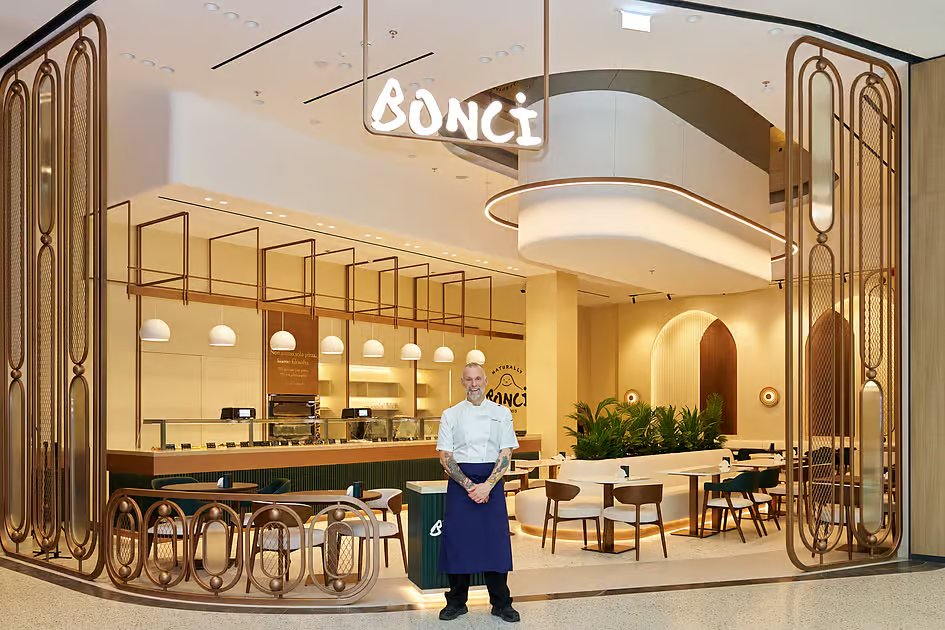
There are certain questions that can quickly expose a pizza purist. Pineapple on pizza is probably the most reliable. Ask Gabriele Bonci, however, and there is no outrage or lecture about what does and does not belong on dough.
Instead, the Roman chef, who has spent decades being described as the “Michelangelo of pizza”, offers an answer that might surprise those who take Italian culinary tradition a little too seriously. “I make it!” he tells Khaleej Times during a recent visit to Dubai for the launch of Bonci at Chef’s Society, City Centre Mirdif. “For me, it is one of the best pizzas.”
It’s perhaps the quickest way to understand Bonci. For a man whose name has become synonymous with Roman pizza al taglio, he is remarkably uninterested in policing what pizza should be. He likes South American pizza because it has “many toppings”, is fascinated by the ways different countries have made the dish their own and sees its evolution not as a corruption of Italian tradition but as evidence of pizza becoming something much bigger. “I like them all because pizza is becoming an ethnic dish,” he says.
Even pineapple, he argues, has earned its place. “It’s the pizza that Americans like. It’s like eating chicken curry or eating rice. It has become an ethnic dish.” And yet, ask him for his own favourite and Bonci returns to simplicity. Pizza rossa with tomato, olive oil, oregano. Nothing else. “That’s number one.”
The ‘Michelangelo of pizza’
That tension between experimentation and simplicity has followed Bonci throughout a career that helped transform the perception of Roman pizza by the slice. His pizzas are thick, airy and cut to order with scissors, piled with ingredients that can make each rectangular slab look closer to a canvas than fast food. It’s partly how he earned that famous nickname.
The “Michelangelo of pizza” label, he explains, came from Vogue America after the publication visited his pizzeria around two decades ago, at a time when Bonci says pizza was undergoing something of a revolution. “I started breaking away from some of the established rules of tradition,” he says.
Roman pizza was a particularly local language then. Unlike the round, made-to-order pizzas that dominate the global imagination, pizza al taglio is baked in large rectangular trays, cut according to how much a customer wants and reheated before serving.
For years, Bonci says, that style largely remained within Rome. Then it began travelling. “There wasn’t even social media yet, but Roman pizza slowly began leaving Rome and going out into the world.”
As his own work gained attention, a younger generation of pizzaioli began experimenting with similar ideas: better ingredients, whole flours and a greater understanding of the grain beneath the toppings.
For Bonci, that last part is imperative to his culinary journey. “Pizza is one of the most consumed foods in the world and through pizza you can create a revolution,” he says. “You can create an agricultural revolution and a revolution of choice.”
It’s why he speaks about flour almost as readily as he does pizza. Bonci says the wheat behind his dough is connected to regenerative agriculture, turning something as ordinary as ordering a slice into, in his mind, a much larger conversation about how food is produced. “Every square centimetre of my pizza represents land cultivated through regenerative agriculture,” he says. “So when you buy my pizza, 50 per cent of what you are buying is pizza and 50 per cent is progress.”
Why Dubai made sense
Now, that philosophy has arrived in Dubai with his latest outing opening in Mirdif City Centre. For Bonci, the city was an obvious place for a food that has always depended on reinvention. “Dubai is a city where something new is designed every day,” he says. “So, I feel that my pizza can grow here too, for sure.”
What he wants to introduce is not simply another Italian pizzeria, but the ritual around Roman pizza al taglio itself. And that includes the scissors.
Bonci’s pizza has what he describes as a “three-dimensional vision”. It’s tall, generously topped and structured vertically, which meant a conventional pizza cutter did not always make sense. “I needed a tool that would allow us to cut it without ruining that structure during service,” he explains. “That is why I started using scissors.”
It has become one of the most recognisable elements of the Bonci experience, but bringing it to a new market also requires getting diners accustomed to a different idea of how pizza should be ordered and eaten. “Bringing this style here is important to me,” he says. “It can be difficult to convince people to eat pizza the way we do in Rome.”
From Michelin ambitions to pizza on the street
Pizza, however, was not always the plan for Bonci. Before becoming one of the world’s most recognisable pizzaioli, Bonci was a young chef working punishing hours in restaurants in Rome. By 25, he says, he had five people working under him and was pursuing a Michelin star.
On paper, it looked like progress. In reality, he was miserable. “I didn’t like the customers. I didn’t like the way I was judged,” he recalls. “You would start trembling because a journalist was sitting at the table. I was already working 20 hours a day in restaurants.”
So, he walked away. “At a certain point I said, ‘I want to do something else.’ I put myself in the middle of the street and created something different.” That something was pizza. And that’s how his journey began with Bonci Pizzarium in Rome, the pizzeria with which his name would eventually become internationally associated, though the chef is no longer involved with it.
But there’s an unmistakable emotion when he talks about those early years. “That is where I started. All my sacrifices are there. My blood and my sweat are there.”
‘Thought makes matter’
Spend enough time speaking to Bonci and pizza begins to sound less like food and more like a vehicle for his worldview. “It’s a pizza made of thought,” he says at one point. “It’s not matter that makes thought, but thought that makes matter.” An idea that seems to extend far beyond what ends up on the plate.
For Bonci, believing in something before it exists is an essential part of creating it, even if that conviction can sometimes appear unrealistic to everyone else. “Many times when you believe deeply in something, people call it utopia,” he says. “Utopia is like an aeroplane. It becomes reality only when it lands.”
There are still plenty of aeroplanes Bonci would like to see land and one of them is his vision for plant-based food. The Italian chef was vegan for 12 years and says he is now moving towards veganism again, an interest that has also made its way into his work.
His historic Roman bakery, Panificio Bonci, has embraced a 100 per cent plant-based approach, with the team creating alternatives in-house, including salami made from mushrooms.
For Bonci, this isn’t just a dietary trend but part of where he believes the wider food industry is heading. “I think that within five or six years, there will be a lot more investment in plant-based food,” he says. And could that philosophy eventually find its way to Dubai too? “Yes,” he replies.
When passion is no longer enough
For aspiring chefs looking at Bonci’s career and imagining passion to be the secret ingredient behind it all, however, he offers a less romantic answer. “Eventually, the passion goes away and only the hard work remains,” he says. A striking admission from someone whose career can so easily be traced through passion.
Perhaps, the point Bonci aims to make is that passion may get you started, but what remains when the excitement wears off is what determines how far you go. “You have to study to move forward,” he adds.
Yet, ask him again about his favourite pizza and his choice remains remarkably simple. Pizza rossa with tomato sauce, olive oil and oregano. The classic. Or, as Bonci puts it, “Number one.”
Source: Khaleej Times
