


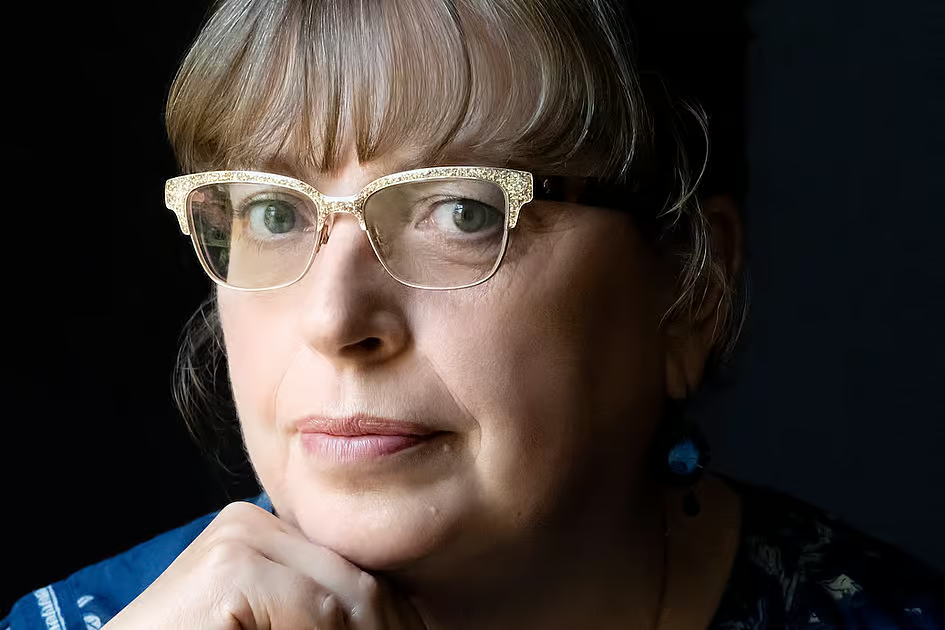
When Tomb of Sand, a seminal Hindi language novel, won the International Booker Prize in 2022, it heralded a new era for contemporary writing in other languages in India. The global focus the prize, won by Indian author Geetanjali Shree and American writer and translator Daisy Rockwell, brought to vernacular writers helped spotlight the robustness of regional literature of India. In the years that have followed the conversation around writing and literature has had another layer of dimension added to it — artificial intelligence. Rockwell, who has translated important works like Bhisham Sahni’s Tamas and Krishna Sobti’s A Gujarat Here, A Gujarat There, says while artificial intelligence has already entered translations, it cannot capture the nuances that make a literary work complex and rich. In town for the Sharjah International Book Fair, Rockwell spoke about her own journey as a translator, what Booker changed for her, and why AI’s role in writing deserves greater scrutiny. Edited excerpts from an interview:
What drew you to translation?
I first started translating in Latin class. In that context you don’t have to make it sound any good and the point is to show you understand the grammar. But over time, I learned about literary translation, which involves creating a literary work of comparable quality and power to the original.
Translation is largely about describing someone else’s world. What does it take to enter another author’s world and inhabit a voice that is as much yours as it is theirs?
Literary translation is about recreating a piece of writing in a different language. I would not say it is describing someone else’s world, because one engages with the world of the text, which is a separate entity from the author. So I would not say I am inhabiting the voice of the author but rather recreating it in English. That means I am interpreting how it sounds for the audience. A translation is always a subjective commentary on the original text created by the translator.
What was your creative process for Tomb of Sand?
It was the same as for any work I translate. First, I write out a very rough draft by hand. That is a draft of the whole book, in which I make no effort to make it sound good. After that, I type it in to the computer. Then begins a process of editing draft after draft. After about the fifth draft, I sent it to Geetanjali Shree and she commented on it extensively. I took her comments into consideration and kept producing drafts, sometimes returning to her with more questions. It was a very difficult book to translate because her use of language is highly unusual and only she can explain what she meant in many cases.
What did winning the International Booker Prize change for the writer in you?
It made my work more widely known and I have had the honour of being invited to a great many interesting places, such as the Sharjah International Book Fair. It also gave me an opportunity to talk about the art of literary translation, for which I am very grateful.
In translation you often come across words that cannot often be interpreted in English or they lose their nuance. Do you remember having any such moment in your journey as a translator?
There are always such moments, but a good translator always finds a way to compensate for such things. A common misconception of literary translation is that it’s simply a word-for-word transfer of meaning. In fact, all those words in the source text are working together to create an overall sensibility. An experienced translator knows how to recreate the meaning through multiple words and phrases, without being hung up on a particular word that is proving difficult.
You translate from both Hindi and Urdu. What does it take to juggle these languages?
Well they are, of course, virtually the same language in spoken form. So in some sense, there is no juggling needed since they have the same grammar and basic vocabulary. I like to translate from both and often I alternate. I find that knowing both languages really well deepens my knowledge of the share literary culture of the two.
Traditionally, the role of translators have been invisible. But they are the ones to make seminal work accessible to a larger audience. In your view, is the invisibility an important part of the job?
Translation has been around since multiple languages have existed. I think over time there have been different attitudes towards the visibility of the translator. For much of the 20th century, invisibility was prized in English translation and publishers looked for works that made the reader forget that the book had not been written in that language. However, that has changed in the 2000s and now translators are entering a visibility phase. That means having our names on book covers and enjoying recognition for the work we do. I think in some contexts it is even unethical to invisible-ise the translator and the fact that the book was not written in English. This is especially true when translating from colonised languages into English, the language of one of the foremost colonisers. We must not participate in the erasure of the source language and culture, and being very clear that a translator created it and struggled with it is important.
You are also a painter. Does painting influence your work as a translator?
I think it does in the sense that I use my visual art skills to envision descriptions in the source text so that I can recreate them in the target language (English).
Literature is not always sanitised. When you encounter uncomfortable aspects like misogyny or any form of bias in a work of literature that is otherwise brilliant, how do you navigate its complexities as a translator and interpret it for an English language readership that is largely sensitive to these issues?
Well, that is a tricky issue. One must take into account the time period of the work and cultural norms in the original culture. Sometimes something might be mildly offensive in one language and incredibly offensive in another. There is a lot of ‘colourism’ in Hindi — characters might make fun of the colour of someone’s skin. It’s certainly offensive in Hindi and it’s meant to be the attitude of the character, not the author. But when we bring some of that into English, it becomes much more offensive, unacceptably so, because of the legacy of slavery in America, for example and American racism. In such contexts, I might do something like keep an ugly nickname like ‘Kaloo’ in the original language because in English, it sounds much worse.
AI is posing a major threat to writing. How will it impact translation in your opinion?
It has already had an impact in the sense that some publishers are trying to get away with using AI to translate literary works instead of humans. What ends up happening is that AI translation sounds terrible, because it misses all the nuances present in literature, and a 30 per cent inaccuracy rate is built in to the way AI works. The problem is that an AI translation sounds smooth and plausible, so it’s very difficult to figure out how to root out the problems. Then these publishers will hire professional translators to ‘fix’ the AI, which is actually much more difficult than simply translating it from scratch. And they will try to pay them a rate much below what they would have been paid to translate it themselves. I have heard many stories from a wide variety of other fields about the same types of problems. AI outputs have to be fixed and then they actually end up taking up much more time and energy than if AI had not been deployed at all. Hopefully, publishers will stop trying to save money this way and stop exploiting talented translators for poorly paid clean-up work.
While we are on the topic of AI, a short story that won the Commonwealth Short Story prize, was accused of having AI influence this year. It raises questions on whether AI can aid in writing something so perfect that can move considered readers. Where do you stand on that?
This is a very problematic issue, because if you look at all the instances of authors being accused of writing fiction using AI, they are almost always people of colour. There is no such thing as a fool-proof AI detection machine, because a vast quantity of literature has been plagiarised to create AI in the first place. I have heard of several published authors inputting their own original work into these AI detectors and getting back results that say that what they have written is 100 per cent AI. This could very well be because their own writing has been plagiarised by the AI scanners and thus it is recognisable to the detectors. We then must ask very seriously why it is only authors of colour who are being viewed with suspicion and if AI detection is being employed in the service of racism and exclusion. I think we will find that the answer is yes.
Source: Khaleej Times
