


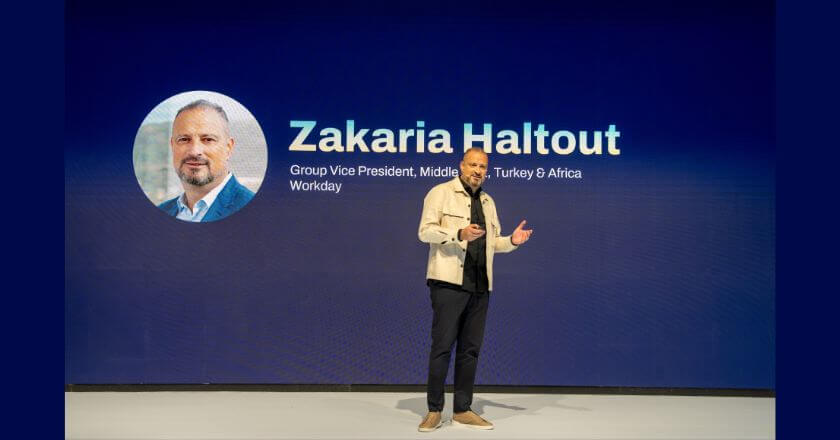
Zakaria Haltout, Group Vice President, Middle East, Turkey and Africa, Workday, discusses the UAE’s digital ambitions, regional growth priorities, and why clear business objectives and employee engagement should guide technology adoption
Enterprise AI adoption across the UAE is shifting from experimentation to everyday use, bringing workforce readiness, human oversight and measurable business value into sharper focus. Workday’s Beyond Productivity: Measuring the Real Value of AI in the UAE report found that 90% of employees use AI at least weekly. Respondents report saving an average of 3.6 hours a week, while spending 3.4 hours clarifying, correcting or rewriting low-quality AI outputs.
Workday’s launch of UAE operations, supported by a new Dubai office and expanded local leadership, comes amid this growing demand for enterprise transformation. The investment aims to help organisations modernise HR and finance, manage change and derive greater value from AI. Workday convened senior leaders including Angelique De Vries-Schipperijn, President, EMEA, and Zakaria Haltout, Group Vice President (GVP), Middle East, Turkey & Africa (META) to mark the opening.
“The UAE is a key market in Workday’s growth strategy, with organisations pursuing transformation against some of the world’s most ambitious national agendas,” said Angelique De Vries-Schipperijn, President, EMEA, Workday. “To succeed, they need technology that helps them move faster, adopt new ways of working, and show clear results while maintaining the trust and control large, regulated organisations require.”
While AI adoption continues to accelerate across the UAE, the research found that realising its full value still depends on human oversight, trust, and continued investment in skills. Employees spend an average of 3.4 hours per week clarifying, correcting, or rewriting low-quality AI- generated outputs, highlighting the continued importance of people, clear rules, and careful review.
Speaking to TahawulTech.com, Zakaria Haltout, Group Vice President, Middle East, Turkey and Africa, Workday, discusses the UAE’s technology progress, the company’s priorities for 2027 and the importance of defining business use cases and preparing employees before selecting technology.
Interview excerpts
Having worked in the region for 18 years, how do you view the UAE’s progress towards becoming a future-ready nation, and how can Workday contribute?
My experience in the region includes 16 years with SAP, where I served as managing director, followed by two years leading the region for UiPath. I joined Workday around nine to ten months ago, when the company established its regional presence. The UAE has consistently demonstrated an appetite for new technologies, innovation and rapid execution. Dubai’s transformation over the past two decades illustrates that ambition. Progress has extended beyond real estate and physical infrastructure to information technology and, increasingly, AI. Cloud adoption initially faced resistance, particularly within the public sector. Organisations soon recognised that cloud would be essential to continued innovation. The UAE approached that transition carefully, with a strong focus on data security, privacy and residency. Encouraging hyperscalers to establish data centres within the country helped address those concerns and supported wider cloud adoption. Cloud provides the foundation for faster deployment, continuous innovation and access to AI capabilities.
Workday wants to contribute to progress by supporting the country’s cloud, AI and workforce transformation priorities.
How is Workday helping UAE organisations turn everyday AI adoption into lasting business value while ensuring trust, human oversight and workforce readiness?
Organisations across the UAE are moving from AI experimentation to everyday use, with 90% of employees using AI at least weekly. But lasting value depends on trust, human oversight, and continued investment in skills, which is why Workday helps organisations bring AI into the flow of work with the context, guardrails, and trusted processes they need to move forward with confidence.
What are Workday’s top priorities for regional growth in 2027?
Workday began building its regional presence in November 2025. I was the first person hired to develop the business across the Middle East, Africa and Türkiye. We are establishing three regional hubs: Dubai, Saudi Arabia and South Africa. Building a talented team has been my first priority, alongside developing our channel and partner ecosystem. Workday already has relationships with global systems integrators, including the Big Four, which have a presence in the region. Local partners are equally important because they bring market knowledge, cultural understanding and expertise in customers’ specific requirements. We are working to strengthen those relationships and have a signing ceremony for a local partnership during this event. Another priority is contributing to the development agendas of Dubai, Abu Dhabi and the wider UAE. Discussions have already begun on how Workday can support their cloud, AI and workforce priorities.
Strengthening our team, expanding the ecosystem and aligning with those national ambitions will remain central to our focus in 2027.
What advice would you give enterprises choosing technologies to accelerate automation and improve business processes?
Before considering any technology, organisations need to understand why they need it. A clear business use case should come first. Without a defined purpose and direction, even the most advanced technology may fail to deliver meaningful value. The second priority is change management. Identifying a use case is only the beginning; successful execution depends on preparing people for the change. Employees may resist new systems, particularly when they worry about the impact on their jobs. Organisations need to communicate the plan, set clear expectations and explain what the transformation means for their workforce. Once the business objective and change management approach are clear, enterprises can assess which technology will best help them achieve their goals. Technology selection should follow that preparation.
Source: Tahawul Tech
