


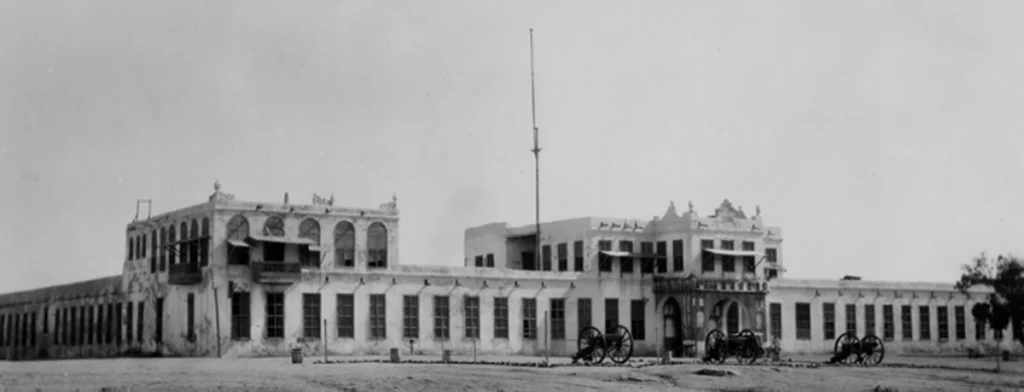
RIYADH — As the new Saudi state grew, some of its most important chapters were written inside palaces that became centers of leadership, administration and diplomacy.
They were residences, but they were also working spaces of a developing state.
At Al-Murabba Palace in Riyadh, Khuzam Palace in Jeddah and the Red Palace in the capital, royal life existed alongside the business of government. Decisions were followed, officials and citizens were received, foreign guests arrived and the expanding responsibilities of the Kingdom were managed.
Together, the palaces offer an architectural record of an important period in Saudi Arabia’s development.
Al-Murabba was among the most significant.
King Abdulaziz bin Abdulrahman Al Saud ordered its construction outside the walls of old Riyadh, reflecting a capital that was itself beginning to expand beyond its historic core.
The complex became closely associated with King Abdulaziz and the administration of the country during the later years of his reign.
Yet Al-Murabba was not solely a place of government.
It was also home.
Memories preserved by members of King Abdulaziz’s family provide glimpses of life there, making the palace a rare place where the public and personal dimensions of the founder’s life intersect.
King Abdulaziz palace in AL-Murabaa.
In Jeddah, Khuzam Palace occupied another important place in the emerging Kingdom.
The palace served King Abdulaziz during his stays in the city and became a venue for official meetings and the reception of guests.
Its architecture eventually became nationally recognizable in its own right.
The King Abdulaziz Foundation for Research and Archives, known as Darah, records that the main gate of Khuzam Palace was depicted on Saudi paper currency issued in 1955.
The image was fitting: a landmark associated with the formative years of the Kingdom had itself become a national symbol carried across the country.
The Red Palace in Riyadh represented another stage in this evolution.
Built during King Abdulaziz’s reign and associated with Prince Saud bin Abdulaziz, it went on to perform important official functions. The palace housed the Royal Court at one stage, received royal guests and later accommodated the Secretariat of the Council of Ministers.
It also welcomed foreign leaders and dignitaries, placing it within the diplomatic life of the developing Kingdom.
The three palaces had different histories, but together they demonstrate how architecture accompanied state-building.
As Riyadh expanded, Al-Murabba represented a new royal and administrative center beyond the old city walls.
As Jeddah served as the Kingdom’s gateway to the world, Khuzam became a setting for royal and official affairs.
And as government institutions grew, the Red Palace became part of an increasingly organized machinery of state.
Eventually, Saudi government would expand into ministries, headquarters and specialized institutions on a scale unimaginable in those early decades.
But some of the foundations were laid in these spaces.
Their importance is therefore greater than their walls, gates and courtyards.
They represent places where leadership was exercised, diplomacy conducted and the affairs of a young Kingdom advanced.
Nearly a century later, they remain architectural landmarks of the era in which modern Saudi Arabia was taking shape.
Source: Saudi Gazette
